
Care Home Fees If Someone Still Lives in the House
If a partner, a relative aged 60 or over, an incapacitated relative or a child under 18 still lives in the property, its value must be left out of the financial assessment entirely, whatever the house is worth. There is no 12-week clock on it and no requirement to sell later.
Last updated: October 2026
In this guide
The Short Answer
This is the question families ask first and worry about most: if Mum goes into a care home, does the house have to be sold while Dad is still living in it?
No. Where a qualifying person still lives in the property as their main or only home, the council must disregard its value from the financial assessment. Not for twelve weeks, not up to a limit. Entirely, and for as long as the qualifying person lives there.
That does not make the care free. Income and any other capital are still assessed on the usual rules, and the £23,250 and £14,250 capital limits still apply to everything else the person owns. It means the house itself is off the table.
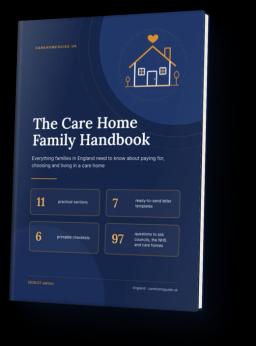
The Care Home Family Handbook
Worried about paying for care? Section 3 of the handbook explains the means test, when the house counts, the 12-week disregard and deferred payments, with a checklist and questions for the council.
See what's inside£47, 14-day money back guarantee
Who Counts
The property must be disregarded where it is occupied, in whole or in part, as their main or only home by any of these people:
- ✓A partner, former partner or civil partner, except where they are estranged
- ✓A lone parent who is the person's estranged or divorced partner
- ✓A relative aged 60 or over, or a member of the family aged 60 or over
- ✓A child of the person going into care who is aged under 18
- ✓A relative who is incapacitated, at any age
Three details in that list are worth pulling out, because the shorthand versions circulating online get them wrong. It is aged 60 or over, not over 60, so someone who is exactly 60 qualifies. It is a child under 18, not under 16. And there is no age limit on an incapacitated relative, so a disabled son or daughter in their thirties qualifies on that limb.
What Counts as a Relative
Wider than most families assume. For this disregard a relative includes any of the following:
- •parent, including an adoptive parent
- •parent-in-law
- •son or adoptive son, and son-in-law
- •daughter or adoptive daughter, and daughter-in-law
- •step-parent, step-son and step-daughter
- •brother and sister
- •grandparent and grandchild
- •uncle and aunt
- •nephew and niece
- •the spouse, civil partner or unmarried partner of most of the above
A member of the person's family means someone living with the qualifying relative as part of an unmarried couple, married to them or in a civil partnership with them. So a 60-year-old daughter-in-law living in the house can bring the disregard into play just as a daughter would.
What Incapacitated Means
The guidance says plainly that the term “is not closely defined”, then gives two routes to it. Either will do.
1. They receive a disability benefit
It is reasonable to treat a relative as incapacitated if they receive any of these: Incapacity Benefit, Severe Disablement Allowance, Disability Living Allowance, Personal Independence Payment, Armed Forces Independence Payment, Attendance Allowance, Constant Attendance Allowance, or a similar benefit.
If they are receiving one of these, say so in writing at the start of the assessment and attach the award letter. It is the quickest way to settle the point.
2. Their degree of incapacity is equivalent
A relative who receives no disability benefit can still qualify if their degree of incapacity is equivalent to that required to qualify for one. Medical or other evidence may be needed before the council reaches a decision, so expect to be asked for a GP letter or similar. Not claiming a benefit is not the same as not being incapacitated, and a council should not treat it that way.
The Condition Nobody Mentions
Almost every version of this list you will read online, including the shorter versions on our own other guides until recently, leaves out the condition attached to it.
The mandatory disregard applies only where the property has been continuously occupied by the qualifying person since before the person went into the care home.
So a daughter who is 62 and has lived with her mother for years brings the disregard into play. A daughter who is 62 and moves in the month after her mother is admitted does not, at least not automatically. The rule exists to protect an existing home, not to create a disregard after the event.
If that is your situation, you are not out of options. Read the next section, because this is exactly what the discretionary disregard is for.
The Discretionary Disregard
Beyond the mandatory list, a council may use its discretion to apply a property disregard in other circumstances. It has to balance that against making sure someone's assets are not maintained at public expense, so it is a judgement rather than a right, but it is a real route and very few families know to ask.
The example the statutory guidance itself gives is where the property is the sole residence of someone who gave up their own home in order to care for the person who is now in a care home, or who is the elderly companion of that person.
The worked example from the guidance
Jayne has early signs of dementia and wants to stay in her own home. She is not assessed as having eligible needs but would benefit from occasional support. Her best friend Penny gives up her own home to move in with her. At that point there is no suggestion Jayne may ever need a care home.
Five years later Jayne's dementia has progressed and an assessment agrees her needs are best met in a care home. On her moving in, the council uses its discretion to apply the property disregard, because the house has by then become Penny's main or only home.
Penny is not a relative, is not a partner and may be nowhere near 60. None of the mandatory limbs covers her. The discretion does.
How to ask for it
Put it in writing at the start of the financial assessment rather than waiting to be offered it, because it will not be offered. Set out who lives in the property, how long they have lived there, what they gave up in order to be there, what care they provided, and what would happen to them if the house had to be sold. Attach anything that evidences the arrangement.
Ask for the decision and its reasons in writing. If the answer is no, ask how to request a review, and see how to complain for the escalation route to the Local Government and Social Care Ombudsman.
What Occupying the House Means
“Occupy” is not closely defined either. In most cases it is obvious, but two situations come up often enough that the guidance addresses them directly.
Living elsewhere but still occupying
Someone can occupy a property as their main or only home without being physically present. The guidance gives a member of the armed services or the diplomatic service posted elsewhere for work, and someone serving a prison sentence who intends to return. In the prison case a council may weigh the length of the sentence and how likely the return is. The person is occupying the property, just not standing in it.
Where it is not enough
An emotional attachment to the property on its own does not bring the disregard into play. The guidance's own example is an adult daughter who lives with her own family elsewhere and stays at her father's house occasionally to help him. It is the house she grew up in, but it is not her main or only home. Where it is unclear, the council should make a factual inquiry weighing all the relevant factors rather than deciding on a rule of thumb.
A Partner's Own Money
A separate worry, and the answer is reassuring. Only the finances of the person going into care are assessed. A husband, wife or partner's own income and savings are not means tested.
Jointly held accounts and investments are usually treated as split equally, so half of a £40,000 joint balance counts as the care recipient's capital. A council should also have regard to a partner remaining at home and make sure they are left with at least the basic income support or pension credit they would be entitled to in their own right.
Our guide to how much savings you will lose works the capital thresholds through with examples.
If Nobody Qualifies
If the house is counted, it will usually put the person above the £23,250 upper capital limit, so they pay the full cost of their care. That still does not mean selling in a hurry. Two things to ask about:
The 12-week property disregard. When someone first enters permanent care and their other capital is below £23,250, the property can be left out for the first twelve weeks. Income and other capital are still assessed, so it does not make the care free, but it buys time.
A deferred payment agreement. The council pays the fees and recovers them from the property later. Eligibility and suitable security are required and it is not automatic.
Both are covered properly in our guide to selling a parent's house and in care home costs. For what happens when savings do eventually run down, see when the money runs out in a care home.
One thing not to do is move the house out of reach. Giving a property away or putting it in a trust once care is foreseeable can be treated as deprivation of assets, and councils can assess someone as though they still owned it. See can you give away assets to avoid care home fees.
Funding information checked 26 October 2026
These rules are for England. The other UK nations have different arrangements, and whether a disregard applies in a particular case is a decision for the council on the facts.
- Care and support statutory guidance, Annex B: treatment of capital. Property disregards and the continuous occupation condition (paragraph 34), the definition of a relative (35) and of a family member (36), the meaning of incapacitated (37), the meaning of occupy and the examples (38 to 39), and the discretionary disregard with the Jayne and Penny example (42)
- DHSC: 2026/27 capital limits and personal expenses allowance (upper £23,250, lower £14,250)
- Weekly fees for context: LaingBuisson via Which?, 9 March 2025, averaging £880 to £1,580 a week across the English regions (2024-25), all residents including council-funded places
Frequently Asked Questions
Will Mum have to sell her house if Dad still lives there?
Does the disregard apply if my brother lives in the house?
What counts as an incapacitated relative?
Does it matter when the relative moved in?
Can the council disregard the house even if nobody on the list qualifies?
What if we are separated but not divorced?
Does the relative have to be living there all the time?
Are my spouse's savings assessed too?
What happens if the qualifying person moves out or dies?
What if nobody qualifies and the house is counted?
The Care Home Family Handbook
Worried about paying for care? Section 3 of the handbook explains the means test, when the house counts, the 12-week disregard and deferred payments, with a checklist and questions for the council.
See what's inside£47, 14-day money back guarantee
Have a question this guide didn't answer?
Ask in our Community Forum and get a real answer from someone who's been through it.
Share what's on your mindRelated Guides
Find care homes in your area
Browse CQC-registered care homes by region, with ratings, inspection dates, care types and contact details. Free to search, no sign-up.
The Care Home Family Handbook
Worried about paying for care? Section 3 of the handbook explains the means test, when the house counts, the 12-week disregard and deferred payments, with a checklist and questions for the council.
See what's inside£47, 14-day money back guarantee