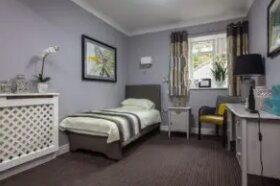
Illustrative image. Photographs of this home have not yet been added.
Woodville
Residential Care
23 July 2026
Ryde House Homes Ltd
7 beds
Rating history
- Aug 2017
- Aug 2026
Rated Good at every inspection since 2017.
Source: CQC inspection reports. Contains CQC data licensed under the Open Government Licence v3.0.
Costs and who runs this home
Run by Ryde House Homes Ltd, which runs 4 care homes in England: 4 rated Good.
Average care home fees in the South East: £1,243 a week for residential care and £1,579 for nursing care (2024-25 averages). Self-funders usually pay more. See our care home costs guide.
- This home lists dementia care, which usually costs more than standard residential care. See dementia care home costs. NHS Continuing Healthcare may apply where someone's needs are primarily health needs.
- How to pay for a care home explains the council means test, what counts as capital and the funding you can ask to be assessed for.
About Woodville
Woodville is a residential care home located in Isle of Wight, South East. Its registered care categories include dementia, learning disabilities, mental health, older people, physical disabilities, sensory impairments, and younger adults. The home has 7 beds. CQC records an overall rating of Good, published in August 2026. The home is operated by Ryde House Homes Ltd.
Specialist Care
Fees and availability
We have not verified a current weekly fee for this home. Ask for a written quote based on the room and care needed, including any extra charges.
Check current vacancies, the admission assessment and visiting arrangements directly with the home.
Care and inspection details
Checked against the CQC register on 21 September 2026. This is a check of published information, not a visit to the home.
- Registered service
- Care home service without nursing
- Registered capacity
- 7 places — this is not a vacancy count
- Registration checked
- Registered · PO33 2NN
Registered care categories
Caring for adults over 65 yrs; Caring for adults under 65 yrs; Dementia; Learning disabilities; Mental health conditions; Physical disabilities; Sensory impairment.
These describe the registration. The home must assess whether it can meet the individual person's needs and whether a place is available.
CQC ratings in more detail
Overall rating shown by CQC: .
Assessment published 24 August 2026. Assessment date recorded: 23 July 2026.
Read CQC's assessment overview
The following is CQC's published account of its assessment, published 24 August 2026. References to “we” mean CQC. It describes findings at that time.
We carried out this assessment between 29 July and 10 August 2026. This service was previously rated as good. We carried out this assessment to confirm whether the rating of good remains accurate. This report does not provide detailed information on areas where we found practice continues to meet a good standard. Instead, our findings focus on any areas where the service needs to improve or where we found exceptional practice.
We have assessed the service against ‘Right support, right care, right culture’ guidance to make judgements about whether the provider guaranteed people with a learning disability and autistic people respect, equality, dignity, choices, independence, and good access to local communities that most people take for granted.
We found the provider had a positive culture of safety and occurrences of accidents and incidents were rare. However, there was limited information available which demonstrated all accidents and incidents had been investigated and action was taken to prevent re-occurrences and mitigate future risk. This was discussed with the management team who agreed to strengthen processes in this area.
People were supported by enough safely recruited staff, who had the skills and knowledge to provide effective support. Staff spoke positively about the level of staffing however, acknowledged people could only attend outside activities in the evening if this was prearranged due to staffing levels. Staff had a range of training and support available to them and confirmed the training they received was of a good quality. One staff member told us, “I’ve done so much training, we get a lot of face-to-face training and it’s of a good standard.”
Staff understood their responsibility to safeguard people from the risk of abuse; they were knowledgeable about what concerns they would need to report and to whom. People's needs were assessed and there was evidence of detailed care planning and risk assessments which contained relevant information about their health conditions, communication needs and support requirements. However, some assessments needed further development to ensure information about people’s sensory needs was clearly described and information about reasonable adjustments was included in people’s hospital passport documentation.
Mental capacity assessments and best interest decisions had been completed where required. For example, where people lacked capacity to make decisions about finances, medicines, and healthcare interventions. People can only be deprived of their liberty to receive care and treatment with appropriate legal authority. In care homes, this can be done through a procedure called the Deprivation of Liberty Safeguards (DoLS), which is part of the Mental Capacity Act 2005 (MCA). We checked whether the service was working within the principles of the MCA and how they managed DoLS within the service. We found that staff and management worked within the MCA. DoLS authorisations were appropriately applied for and overseen. People were not subject to unlawful or excessive restrictions they had choice, control and freedom over their lives.
There were safe systems in place for the management, storage and administration of medicine and people received their medicines when they needed them. We observed staff supporting people safely with medicines with a person-centred approach that was consistent with information in peoples’ support plans.
- Safe
- Effective
- Caring
- Responsive
- Well-led
Contains Care Quality Commission information under the Open Government Licence v3.0. Ratings and registration details can change after the date checked.
5 Questions to Ask on Your Visit
When visiting Woodville, consider asking...
- 1.What specific dementia training do staff receive and how recently?
- 2.How do you support a resident who becomes distressed or confused?
- 3.How does the home keep a record of a resident's life history and personal preferences?
- 4.How do you involve families as dementia progresses and communication becomes harder?
- 5.What happens when a resident's dementia reaches an advanced stage?
5 Things to Look For on Your Visit
When you visit Woodville, look out for...
- 1.Is the environment calm, uncluttered and easy to navigate?
- 2.Do staff speak to residents with patience and dignity, even if they repeat themselves?
- 3.Are there memory cues around the home -- photos, familiar objects, clear signage?
- 4.Do residents seem settled and safe, or agitated and unsupervised?
- 5.Is there meaningful activity happening, or are residents just sitting quietly with nothing to do?
Could the NHS fund Woodville's fees?
The average nursing home costs £1,535 per week. That's £79,820 a year. NHS Continuing Healthcare could cover all of it. No means test, no contribution from you.
Location
91 West Street, Ryde, Isle Of Wight, PO33 2NN

Woodville
CQC overall rating
Assessment date: 23 July 2026
Helpful Guides
Have a question about this care home?
Ask in our Community Forum and get a real answer from someone who's been through it.
Share what's on your mindFind Out If Woodville Is Right for You
Start the conversation and request a callback from this home.
A free daily companion for someone with dementia
Shows the date, weather, family photos, and a daily question. Set up in 10 minutes.
Other Care Homes Near PO33 2NN
Listings with similar recorded care types and specialisms are shown first. Confirm care needs and availability directly with each home.

22 Argyll Street
22 Argyll Street, Ryde, Isle of Wight
Residential care
0.2 miles away (straight-line distance)
Merrydale Residential Home
Merrydale, 90 Spencer Road, Ryde, Isle of Wight
Residential care
0.4 miles away (straight-line distance)

Victoria House
22 Nelson Place, Ryde, Isle of Wight
Residential care
0.4 miles away (straight-line distance)
St Vincents Retirement Home
Binstead Road, Ryde, Isle of Wight
Residential care
0.4 miles away (straight-line distance)
The Adelaide
Adelaide Place, Ryde, Isle of Wight
Residential care
0.4 miles away (straight-line distance)
Ryde Cottage
Ryde House Drive, Binstead Road, Ryde, Isle Of Wight
Residential care
0.5 miles away (straight-line distance)